Crocus Flower Planting Tips for Fall to Enjoy Beautiful Spring Blooms
The first crocus of spring feels almost impossible. One week the garden is grey, the soil is cold, and the lawn looks half asleep. Then a small cup-shaped flower pushes through, sometimes right through a crust of snow, and suddenly the whole season changes.
That is the charm of crocus. These small spring bulbs, more accurately called corms, do not need much space or fuss. Plant them in fall, forget about them through winter, and they reward the garden with colour when almost nothing else is awake.
Crocuses are some of the easiest bulbs to grow across much of Canada, as long as they get the right start before the ground freezes. With a little planning, they can brighten lawns, borders, rock gardens, containers, and the bare soil under deciduous trees.

Crocus flowers are small, tough, and full of spring promise
Crocuses belong to the iris family and grow from corms, not true bulbs. A corm is a swollen underground stem that stores energy for the next season. Gardeners often call them bulbs because they are planted in the same way as tulips, daffodils, and hyacinths.
Most spring-blooming crocuses flower very early, often before grass starts growing well. Their flowers open in sunlight and close at night or on cloudy days. This simple habit helps protect the bloom from cold, wet weather.
Common colours include:
Soft lavender
Deep purple
White
Cream
Yellow
Striped purple and white
Crocuses rarely grow tall. Many reach only 8 to 15 cm, which makes them easy to tuck into places where larger spring bulbs would look awkward. Their slim, grass-like leaves appear with or just after the flowers. A pale stripe often runs down the centre of each leaf.
One of the best things about crocus flowers is how early pollinators use them. On warm late-winter or early-spring days, bees may visit open crocus blooms when few other food sources are available.
A small drift of crocuses can do more for a spring garden than a single large plant, especially when the flowers are grouped where they can be seen from a window or walkway.
Crocuses also suit many garden styles. They look natural in lawns, neat in formal beds, cheerful in containers, and charming at the edge of stone paths. The key is to plant enough of them. A single crocus is sweet. A cluster of 25 or more looks intentional.
Fall is the right time to plant crocus corms
Crocuses need a cold period before they bloom. Fall planting gives the corms time to settle in, grow roots, and experience winter chilling. That is what sets them up for spring flowers.
Across Canada, timing depends on climate and soil temperature. The goal is to plant after the worst summer heat has passed but before the ground freezes solid.
A simple rule works well: plant crocus corms about 4 to 6 weeks before the soil freezes.
Region type | General planting window | What to watch for |
Colder prairie and northern areas | September to early October | Plant before hard frost locks the soil |
Southern Ontario and southern Quebec | Late September to October | Wait until soil cools but do not delay too long |
Atlantic Canada | October is often suitable | Avoid planting into soggy soil |
Coastal British Columbia | October to November | Good drainage matters during wet winters |
These windows are general. A warm fall may stretch the season. An early freeze may shorten it. If the soil can still be worked and corms feel firm, they can usually still be planted.
Do not plant too early during hot weather. Warm soil can encourage weak top growth before winter. Crocuses need root growth in fall, not leaves above ground.
When buying corms, choose ones that feel firm, dry, and heavy for their size. Avoid corms that are soft, mouldy, shrivelled, or badly damaged.
Bigger corms often produce stronger flowers in the first year. Smaller corms can still grow, but they may take longer to build a full display.
Choose a spot where crocuses can wake up early
Crocuses bloom best in sun, but the idea of “full sun” is a little different in early spring. A spot under a maple, birch, or ornamental crabapple may be sunny when crocuses bloom because the tree has not leafed out yet.
That makes crocus a smart choice for planting under deciduous trees and shrubs. They finish much of their active growth before the shade becomes heavy.
Good places to plant crocuses include:
Along a front path
Near a porch or patio
At the front of a perennial border
Under deciduous shrubs
In rock gardens
In small clusters through a lawn
Around early daffodils or dwarf iris
In containers that can stay cold in winter
The most important site feature is drainage. Crocus corms dislike sitting in wet soil, especially during winter. If a spot stays puddled after rain or snowmelt, choose another area or improve the soil before planting.
Heavy clay soil can still work if it does not stay soaked. Mix in compost to improve structure, but avoid making a soft, rich pocket surrounded by dense clay. That can create a small bowl that holds water around the corms.
Sandy soil usually drains well, though it may dry out quickly in spring. A thin layer of compost helps hold enough moisture for good root growth.
For lawns, crocuses look best when planted in natural drifts rather than straight lines. Toss the corms lightly onto the grass and plant them where they land. This creates a relaxed pattern that looks less staged.
There is one trade-off with lawn planting. Crocus leaves need time to make energy after flowering, so mowing must wait until the foliage yellows. If the lawn needs to look clipped very early, plant crocuses in beds instead.
Plant crocus corms at the right depth and spacing
Crocus planting is quick, but small details matter. If corms are too shallow, frost heave and squirrels can disturb them. If they are too deep, flowers may struggle to emerge, especially in heavy soil.
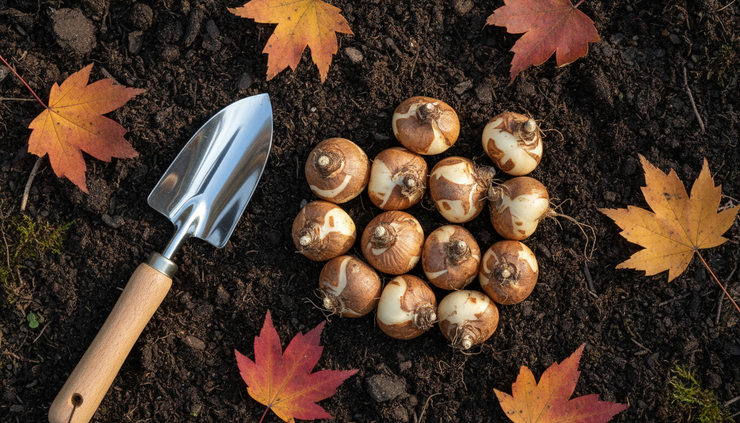
For most spring crocuses, plant corms about 7 to 10 cm deep. Space them 5 to 8 cm apart for a full look. In very loose or sandy soil, plant near the deeper end of that range. In heavy soil, stay closer to the shallower end as long as the corms are still well covered.
The pointed end usually faces up. The flatter end sits down. If it is hard to tell, place the corm on its side. Crocuses are good at correcting themselves as they grow.
Use this simple planting method
Loosen the soil
Work the soil to a depth of about 10 to 15 cm. Remove weeds, stones, and compacted clumps.
Add compost if needed
Mix in a modest amount of finished compost. Skip fresh manure, which can be too strong and may encourage rot.
Place the corms in groups
Set corms in clusters of 10, 15, or more. Groups look better than single dots scattered far apart.
Cover and firm the soil
Replace the soil and press gently with your hands. Firm soil helps remove large air pockets.
Water once
Water after planting to settle soil around the corms. After that, fall rain often supplies enough moisture.
Add a light mulch
A thin layer of shredded leaves or fine mulch helps protect the soil surface. Keep it light so shoots can emerge easily.
If squirrels are a problem, lay a piece of chicken wire over the planting area and secure it with landscape pins. Cover it with mulch so it disappears from view. The crocus shoots can grow through the openings, while digging animals have a harder time reaching the corms.
Another trick is to plant crocuses among daffodils. Squirrels and deer usually avoid daffodils, and mixed plantings can reduce attention on the crocus corms. It is not a perfect shield, but it can help.

Mix crocus varieties for a longer spring show
Not all spring crocuses bloom at exactly the same time. Planting a few types can extend the display and add more colour.
Large-flowered Dutch crocuses are common and easy to find. They tend to produce bigger blooms in purple, white, yellow, or striped forms. They make a clear show in borders and lawns.
Species crocuses are smaller and often bloom earlier. They can look more delicate, but many naturalize well when planted in a suitable spot. They are lovely in rock gardens, under shrubs, and near pathways where their details can be seen up close.
Good planting combinations include:
Purple crocuses with early yellow daffodils
White crocuses under dark-stemmed shrubs
Striped crocuses along stone edging
Yellow crocuses near blue dwarf iris
Mixed crocuses scattered through a sunny lawn
For the most natural look, plant each variety in small sweeps or clusters rather than mixing every colour evenly. Nature rarely spaces colours like confetti. A patch of purple beside a smaller group of white often looks calmer and more pleasing.
Be careful with names when shopping. “Autumn crocus” often refers to Colchicum, which is not a true crocus and blooms in fall. It is also highly toxic. Spring-blooming crocus corms are the ones most gardeners plant in fall for early spring flowers.
Saffron crocus, or Crocus sativus, is a true crocus, but it blooms in fall, not spring. It is grown for the red stigmas used as saffron. It has different timing from the spring crocuses discussed here.
Care for crocuses after they bloom
Once crocuses finish flowering, the leaves keep working. They gather sunlight and send energy back into the corm for next year’s bloom. Cutting the leaves too early weakens the plant.
Let crocus foliage yellow and fade on its own. In beds, nearby perennials often grow up and hide the aging leaves. In lawns, delay mowing the planted area until the leaves have turned yellow. This may mean waiting several weeks after bloom.
Crocuses usually do not need much fertilizer in decent garden soil. If growth weakens over time, top-dress the area with compost in fall. A bulb fertilizer can also be used according to label directions, but avoid overfeeding. Too much nitrogen can encourage leaves at the expense of flowers.
Water is rarely needed in early spring unless the soil is unusually dry. Crocuses prefer moisture while growing, followed by drier conditions during dormancy.
If clumps become crowded after several years, flowers may get smaller. Dig and divide the corms after the foliage has died back. Replant the healthiest corms at the proper depth.
Common problems are usually easy to read:
Problem | Likely cause | What to do |
Few or no flowers | Foliage was cut too early the previous year | Let leaves yellow naturally this season |
Corms disappear | Squirrels or rodents dug them up | Use wire mesh or plant in protected spots |
Corms rot | Soil stays too wet | Move plantings to a better-drained area |
Leaves grow but blooms are weak | Clumps may be crowded or underfed | Divide after foliage dies back and add compost |
Flowers flop quickly | Warm spring weather or heavy rain | Plant in part-day sun to slow bloom time slightly |
Crocuses are low-maintenance, but they are not no-maintenance. Their main request is simple: let them keep their leaves long enough to recharge.

Small fall effort, big spring reward
Crocuses prove that a garden does not need to wait until May to feel alive. A handful of corms planted in cool fall soil can bring colour to the first mild days of spring, often when snow still lingers in shaded corners.
Choose firm corms, plant them 7 to 10 cm deep, group them generously, and give them a spot with spring sun and good drainage. After flowering, let the leaves fade naturally so the corms can store energy for next year.
That is the whole rhythm: plant in fall, wait through winter, enjoy the first bright cups of spring. For such a small flower, crocus has a remarkable way of making the garden feel hopeful again.


Comments